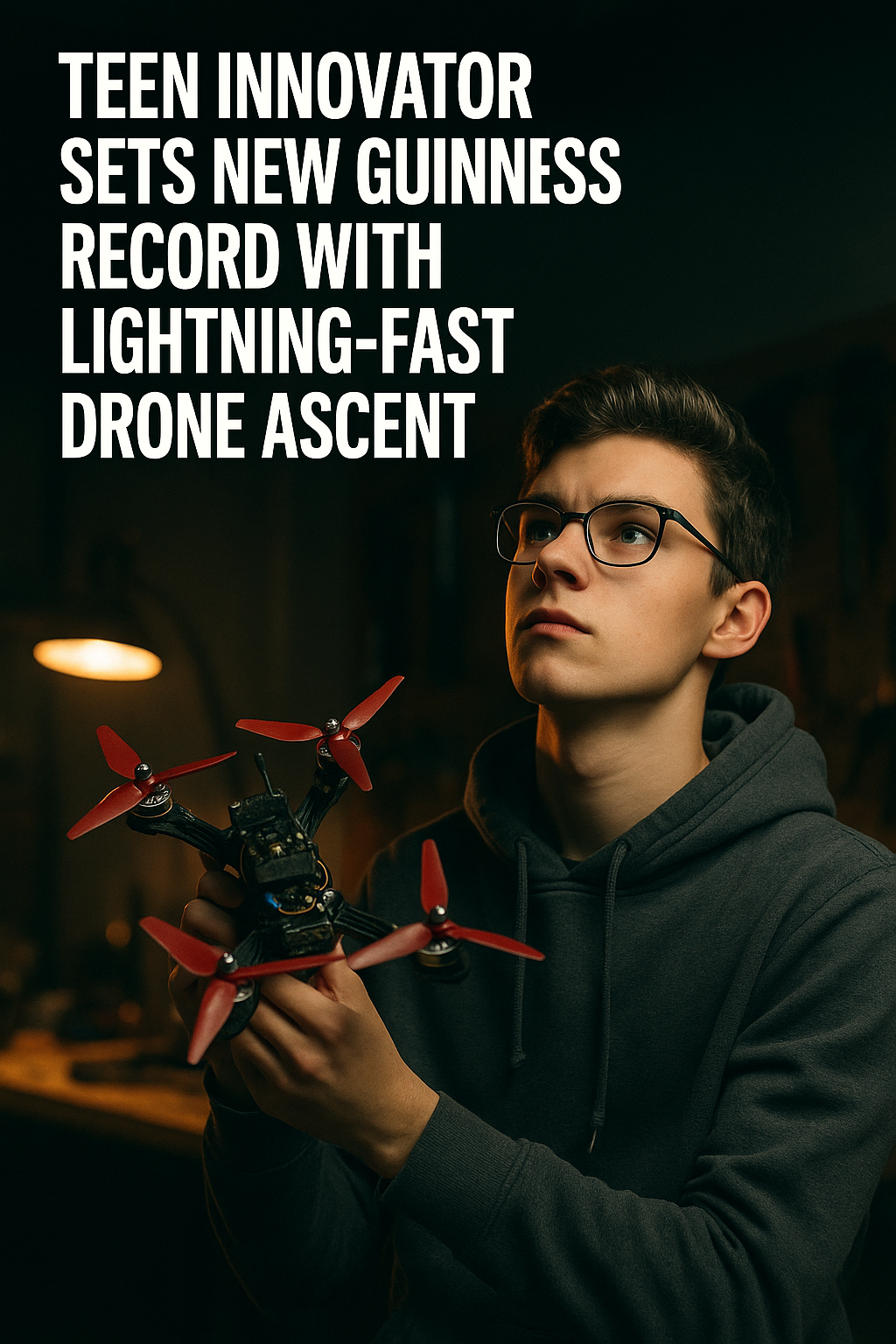
At just 17 years old, Mehar Singh has made headlines worldwide by smashing the fastest 100‑meter drone ascent record with a custom quadcopter that reached 100 metres in a breathtaking 0.91 seconds. The record‑breaking flight was certified by Guinness World Records on August 28, 2024, putting India on the map as a hub for high‑speed drone innovation.
Background and Context
India’s drone industry has seen exponential growth since the 2016 Civil Aviation Requirements Final Order, which relaxed restrictions on commercial drone operations. In that environment, budding engineers and hobbyists suddenly had access to advanced propulsion systems and sophisticated sensor suites. Mehar Singh, currently a senior at Delhi Public School, New Delhi, entered this arena during secondary school, driven by his fascination with aerodynamics and robotics.
His achievement arrives at a crucial juncture: governments worldwide are exploring autonomous delivery, disaster response, and rapid‑deploy reconnaissance. A record like Mehar’s not only demonstrates individual brilliance but also signals that Indian innovators can compete with the best global tech centers, including Silicon Valley and Shenzhen.
Key Developments
1. Design Breakthroughs – Mehar’s drone, dubbed “AeroBolt,” integrates a lightweight carbon‑fiber frame with a centrifugal rotor stack, allowing the propellers to spin at 12,000 RPM. This configuration delivers a thrust‑to‑weight ratio that allows the quadcopter to overcome gravitational forces in less than a second.
2. Software Optimisation – The flight controller runs on an ultra‑low‑latency microcontroller, running firmware that leverages predictive algorithms to fine‑tune motor power in real time. Machine‑learning‑based sensor fusion reduces vibration, stabilising the ascent trajectory.
3. Testing Protocols – Over 300 iterative prototypes were built, each undergoing rigorous stress tests, wind tunnel experiments, and full‑scale launch trials. Failures were logged and analysed using an AI‑driven diagnostics tool that identified component fatigue and aerodynamic drag points.
4. Record Validation – The Guinness World Records team conducted four live trials over a calibrated 100‑metre test chute in Bengaluru’s International Air Show grounds. High‑speed cameras captured the ascent, and real‑time telemetry verified the time stamp at 0.91 seconds. The record is now listed under “Fastest 100‑meter Drone Ascent Record.”
Impact Analysis
For students worldwide, the record shows that practical engineering can compete with high‑budget labs. In universities where funding is limited, Mehar’s methodology—combining open‑source CAD tools with community‑driven hardware—demonstrates how to generate world‑class results with relatively modest resources.
International students chasing admission to aerospace or robotics programs can cite this record as proof that hands‑on experimentation and systemic troubleshooting are valued in academia. Moreover, the record highlights:
- Strategies for prototyping at scale without prohibitive costs.
- The importance of data analytics in iterative design.
- Networking with global registries (Guinness, FAA, EASA) to legitimize achievements.
Educational institutions may incorporate similar challenges into their curricula, fostering an environment where students can claim tangible, globally recognized milestones. This can enhance grant‑seeking proposals, research collaborations, and student‑led innovation festivals.
Expert Insights and Practical Tips
According to Dr. Kavita Rao, Chair of Drone Innovation at the Indian Institute of Technology, Kanpur, “Mehar has leveraged the combinatorial power of lightweight materials and precise software tuning. Students should focus on three pillars: (1) material selection, (2) sensor fusion, and (3) statistical testing.” She adds that a student budget of $5,000–$7,000 can cover a full prototype set‑up, including a 3D printer, carbon‑fiber walls, and a Raspberry Pi‑based flight controller.
For international students, the following practical tips can help replicate similar feats:
- Start with a clear metric. Define what “fastest ascent” means in terms of thrust, mass, and wind conditions.
- Use open‑source resources. Platforms like Ardupilot and PX4 provide community‑maintained firmware; GitHub hosts countless collision‑avoidance libraries.
- Adopt a data‑driven approach. Record telemetry for each flight, and apply regression analysis to pinpoint variables that improve acceleration.
- Engage with local regulatory bodies. Secure temporary flight permissions, ensuring safety compliance and easing record verification processes.
- Document every iteration. Maintain a lab notebook (digital or paper), as Guinness and many academic review boards require detailed methodology logs.
Finally, remember that the journey is as important as the destination. Mehar says, “Every crash was a lesson; the record is a by‑product of relentless experimentation.”
Looking Ahead
The implications of Mehar’s record stretch far beyond a single accolade. Rapid vertical ascent capabilities open new doors in:
- Emergency medical transport – delivering life‑saving supplies to hard‑to‑reach sites.
- Search and rescue operations – hitherto impossible terrains can be surveyed quickly.
- Space‑based logistics – small payloads could be lofted with minimal energy, reducing launch costs.
- Urban infrastructure inspection – high‑speed drones can inspect bridges, skyscrapers, and pipelines with minimal downtime.
Manufacturers are already citing the AeroBolt design as a reference in next‑generation urban micro‑air vehicles. Academic research groups in the United Kingdom and Japan have begun joint projects to integrate similar propulsion concepts with advanced AI navigation. For students, these developments indicate that the next wave of aerospace curricula will put high‑speed maneuvering at its core.
In the meantime, Mehar’s story continues to inspire a new generation of innovators. His record demonstrates that with curiosity, perseverance, and a systematic approach, even 17‑year‑olds can set world‑class milestones that resonate globally.
Reach out to us for personalized consultation based on your specific requirements.